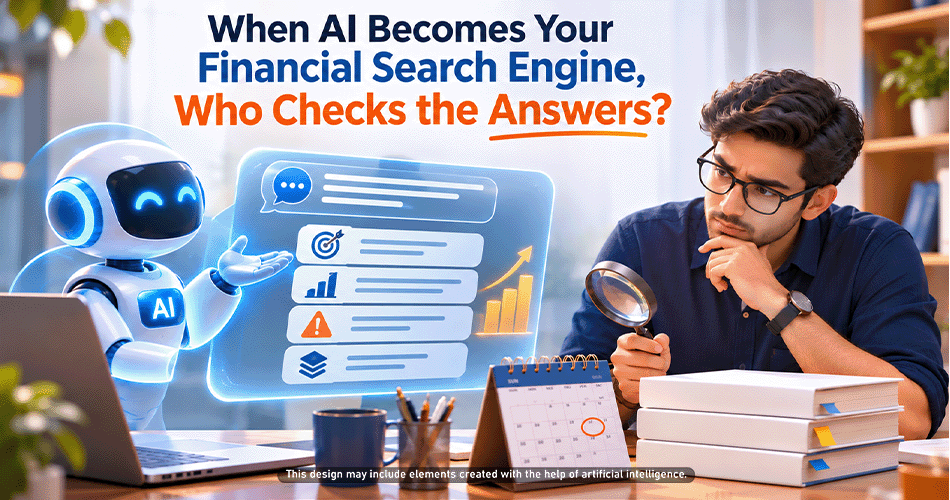
Imagine asking an AI chatbot a simple question: “Which mutual fund category is suitable for a five-year financial goal?”
Within seconds, you may receive a detailed response explaining different fund categories, potential risks, historical performance, and possible investment approaches.
The answer is neatly organised, easy to understand, and sounds convincing.
You might even receive a comparison table, a few statistics, and a confident conclusion.
But there is one question worth asking before relying on that response.
Where did the information come from, and is it actually correct?
Artificial intelligence is changing how people access financial information. Instead of browsing multiple websites or reading lengthy documents, investors can now ask questions in everyday language and receive instant explanations.
This convenience has genuine value. However, when the subject involves personal finances, an answer that sounds knowledgeable is not necessarily an answer that has been verified.
One of the most interesting characteristics of generative AI is its ability to produce fluent, structured responses.
It can explain complicated topics in simple language, compare concepts, and organise large amounts of information.
However, generative AI systems can sometimes produce incorrect information while presenting it with confidence.
This phenomenon is commonly known as an AI hallucination.
For example, imagine asking an AI tool about the expense ratio of a particular mutual fund scheme.
The chatbot may provide the correct percentage. However, it could also present an outdated figure or one belonging to a different plan of the same scheme.
The answer may appear credible because it contains a scheme name, a number, and a detailed explanation.
Yet the accuracy of the information may still need to be verified.
Financial information is particularly sensitive to such errors because small differences can matter. A scheme's expense ratio, risk classification, investment mandate, or exit-load structure may influence how an investor evaluates it.
The concern is not simply that AI can make mistakes.
It is that a well-written answer can make those mistakes difficult to recognise.
Some financial concepts remain relatively stable over time.
The basic meaning of diversification, inflation, asset allocation, or a Systematic Investment Plan does not change every day.
Other information can change frequently.
Mutual fund NAVs are updated based on the applicable valuation process. Expense ratios can change. Scheme portfolios evolve. Regulations and taxation provisions may also be revised.
An AI model that relies on older information may provide an explanation that was once accurate but is no longer current.
Even AI tools with internet access are not automatically immune to this problem. They may occasionally retrieve outdated pages, misunderstand publication dates, or combine information from different periods.
Consider an investor asking about the taxation of a particular investment.
If the answer is based on provisions applicable to an earlier financial year, it could lead to an incorrect understanding of the current rules.
Similarly, a chatbot might describe a scheme using an investment strategy that has subsequently changed.
This makes the date of the information almost as important as the information itself.
For time-sensitive financial questions, the relevant issue is not merely whether AI can provide an answer, but whether that answer reflects the latest applicable information.
Fortunately, investors do not need to rely exclusively on an AI-generated explanation.
India's financial ecosystem provides several official sources that can help verify important details.
Different sources serve different purposes:
For example, if an AI tool states that a particular mutual fund follows a specific investment strategy, the Scheme Information Document and the latest relevant disclosures can help verify that claim.
If the question concerns a regulatory requirement, the applicable SEBI circular or regulation is a more authoritative source than an unsupported chatbot response.
And when checking performance data, investors should pay attention to the relevant scheme plan, option, time period, and date.
A source being mentioned in an AI answer does not necessarily mean the information has been correctly interpreted.
The original document still matters.
There is another limitation that goes beyond factual accuracy.
Suppose two individuals ask the same AI chatbot:
“Should I invest in an equity mutual fund?”
One person is 25 years old, has stable income, sufficient emergency savings, and a long investment horizon.
The other is 58 years old, expects to use the money within two years, and has limited capacity to absorb losses.
The same investment category could have very different implications for these individuals.
A chatbot may explain the characteristics of equity mutual funds accurately, but a general response alone may not establish whether a particular investment is appropriate for either person.
Suitability depends on several factors, including financial goals, investment horizon, risk appetite, liquidity requirements, and existing investments.
Even when users share personal details, an AI system may not have complete or reliable information about their financial circumstances.
There is also a privacy consideration. Entering account numbers, detailed financial records, or other sensitive information into an AI service requires understanding how that service handles data.
AI-generated information can support financial learning, but it should not automatically be treated as a comprehensive assessment of personal investment suitability.
AI can also influence financial decisions through the way questions are framed.
Imagine someone who already believes that a particular mutual fund category will perform well.
They ask:
“Why is this category a good investment right now?”
The wording may encourage an explanation focused on reasons supporting that existing belief.
A more balanced question would be:
“What are the characteristics, risks, limitations, and circumstances in which this category may be unsuitable?”
This relates to confirmation bias, the human tendency to favour information that supports existing opinions.
AI does not create this bias, but conversational tools can sometimes make it easier to seek reassuring explanations repeatedly.
An investor may continue refining questions until the response aligns with what they already wanted to hear.
This can create a false sense of independent validation.
However, AI can also help challenge existing assumptions when users ask questions that explore different perspectives.
A useful way to approach AI-generated financial information is to explore alternative viewpoints rather than using the tool solely to strengthen an existing assumption.
AI has made financial information easier to access, but it has not removed the need to evaluate that information.
An explanation can be clear yet incomplete. A statistic can be precise yet outdated. A recommendation can sound reasonable while overlooking an individual's circumstances.
The real advantage of AI may therefore lie in helping investors ask more informed questions, rather than accepting every answer it produces.
Before relying on an AI-generated financial claim, one simple habit can make a meaningful difference:
Check the source, check the date, and understand the context.
Because when financial information becomes available in seconds, knowing what deserves verification becomes an important part of financial literacy.
This content is for investor education purposes only. It should not be treated as investment advice or a recommendation. Mutual Fund investments are subject to market risks, read all scheme related documents carefully.


Risk Factors – Investments in Mutual Funds are subject to Market Risks. Read all scheme related documents carefully before investing. Mutual Fund Schemes do not assure or guarantee any returns. Past performances of any Mutual Fund Scheme may or may not be sustained in future. There is no guarantee that the investment objective of any suggested scheme shall be achieved. All existing and prospective investors are advised to check and evaluate the Exit loads and other cost structure (TER) applicable at the time of making the investment before finalizing on any investment decision for Mutual Funds schemes. We deal in Regular Plans only for Mutual Fund Schemes and earn a Trailing Commission on client investments. Disclosure For Commission earnings is made to clients at the time of investments.
AMFI Registered Mutual Fund Distributor – ARN-162129 | Date of initial registration ARN – 04-Apr-2019 | Current validity of ARN – 03-Apr-2028
Important Links | Disclaimer | SID/SAI/KIM | Code of Conduct | SEBI Circulars | AMFI Risk Factors